
Your School Is Profitable. So Why Is There No Money in the Bank?
Understanding the difference between cash and profit—and why your childcare business needs both.
You open your Profit & Loss statement and see a profit. Great news, right?
Then you look at your bank account and suddenly you're wondering: If we're profitable…where is all the money?
If you've ever felt this way, there's a financial concept that can completely change how you look at your childcare business: Cash and profit are not the same thing.

Meet Our Runners: Cash and Profit
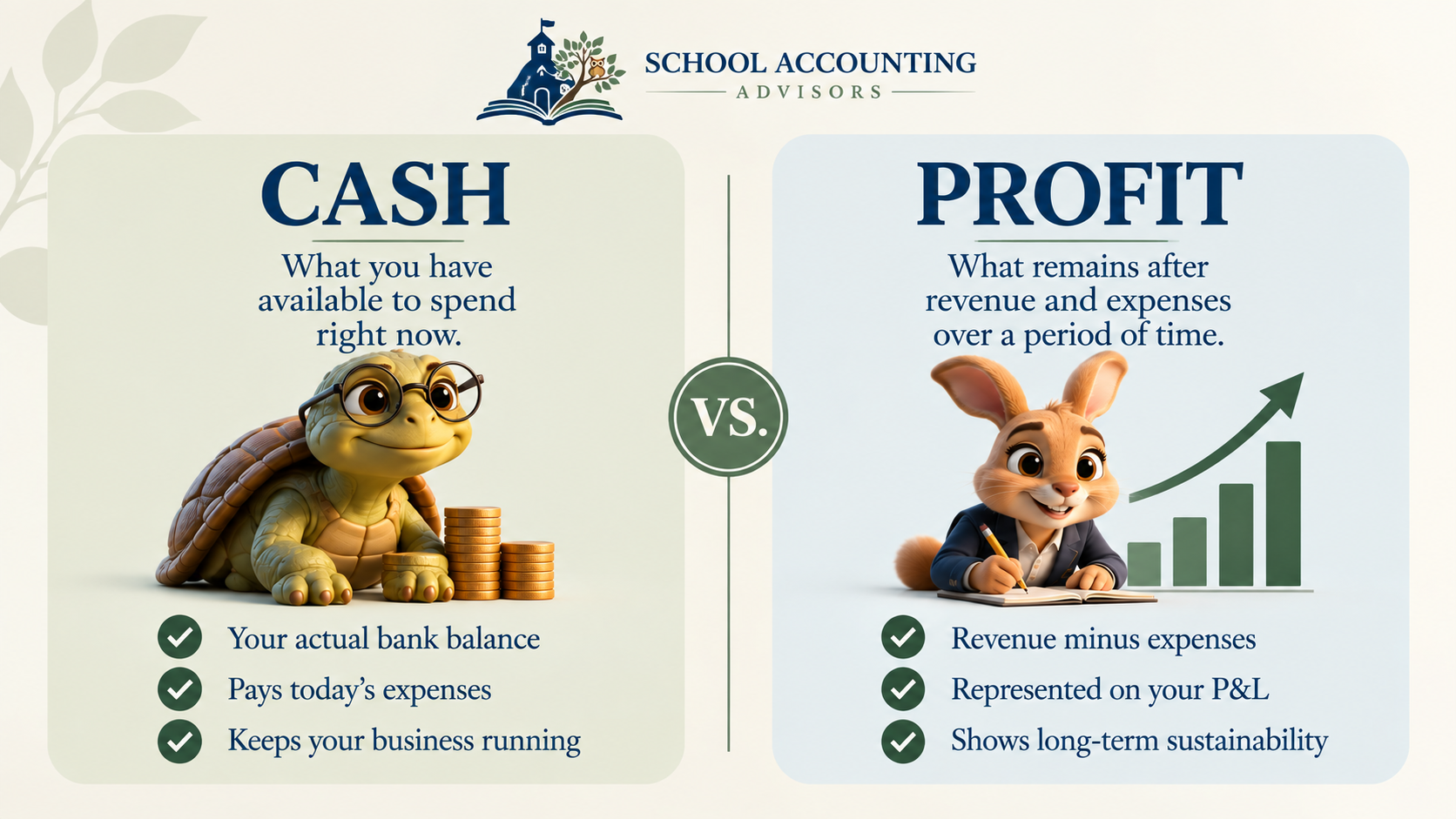
I like to think about cash and profit as the tortoise and the hare.
Cash is our tortoise. Steady. Reliable. Maybe not particularly exciting—but absolutely essential. Cash tells us how much money the business actually has available right now.
Profit is our hare. Profit gets a lot of attention.
"Are we profitable?"
"What's our margin?"
"How much did we make this year?"
Profit tells us whether the business's revenue exceeded its recorded expenses over a period of time. Both matter. But they don't always move at the same speed and that is where school owners can get into trouble.
How Can a Profitable Childcare Center Run Out of Cash?
Imagine that your financial statements say your center earned a profit this year. That does not necessarily mean the same amount of money is sitting in your bank account. Here are several reasons why.
1. You've earned money that hasn't arrived yet.
This is especially familiar to childcare providers receiving government reimbursements when those reimbursements come late or at unpredictable times. The children were in your care, the teachers worked and were paid, you bought the supplies, and paid your bills. You've earned the revenue—but the payment hasn't arrived.
Your annual numbers may ultimately show a profitable operation while you're struggling to make it through a particular month or season. That's a timing problem, and timing problems can become very real cash problems.
2. You're paying back debt.
This one surprises a lot of business owners because when you make a business loan payment, only the interest portion of the payment has an impact on your Profit & Loss statement. The principal repayment reduces what you owe on the loan. It takes real money out of your bank account, but does not affect your profit and loss statement.
So your business can report a profit while significant amounts of cash are going toward debt repayment. This is a fairly common scenario for schools that are just becoming profitable. The owners are often trying to pay down high interest loans, which makes sense. But those payments take cash and can leave the owner feeling like there is not money, even when the school is operating profitably.
3. You're taking money out of the business.
Owner draws don't show up as expenses on your Profit & Loss statement, but they absolutely reduce the cash available to the business. I've seen businesses get into cash trouble because the owner looked at the bank balance, saw money available and transferred what was there to meet personal expenses. Then something unexpected happened and the business didn't have the cushion it needed.
The question isn't simply: "Is there enough money for me to take a draw today?"
A better question is: "After I take this money out, does the business still have enough cash for what's coming?"
“On paper, you made money, but you may not feel like you have that money anymore.”
4. Taxes arrive after the profit does.
Your first really profitable year can actually be one of the years when cash requires the most attention.
Maybe you've spent the year catching up.
You're paying off loans from difficult years.
You've finally been able to take some money home.
The business feels like it's recovering. Then comes the tax bill. On paper, you made money, but you may not feel like you have that money anymore. This is why tax planning and cash planning need to talk to each other.
5. You made major purchases.
Buildings, land, vehicles, playground equipment and other large purchases can create another disconnect between what happens to cash and what appears on the Profit & Loss statement. You may spend significant cash without seeing an identical expense hit your P&L at the same time. In 2026 bonus depreciation can help with the timing issues on some assets, but not not all assets qualify.
Once again: Cash and profit are running the same race—but they aren't necessarily running side by side.
The Opposite Problem: Cash Doesn't Automatically Mean You're Profitable
Now let's flip the situation. Your bank account looks fantastic!! Does that mean your childcare center is financially healthy? Not necessarily. Maybe families prepaid tuition you received a loan, or delayed expenses. All of those situations can temporarily make the bank account look healthier than the underlying business. That's why I don't want owners managing their schools by looking at the bank balance alone.
A positive bank balance answers: "Do I have cash?"
It doesn't necessarily answer: "Does my business model work?"
So Which One Matters More?
Both.
But the one that needs your attention first depends on the problem you're facing. If you can't make payroll next Friday, we have a cash problem. Cash gets our immediate attention because a profitable business can still fail if it runs out of money.
But if your childcare center consistently spends more than it generates, we have a profitability problem. A loan might temporarily solve the cash shortage, but it cannot permanently solve an unprofitable business model. Eventually, we have to fix the underlying economics of the center.
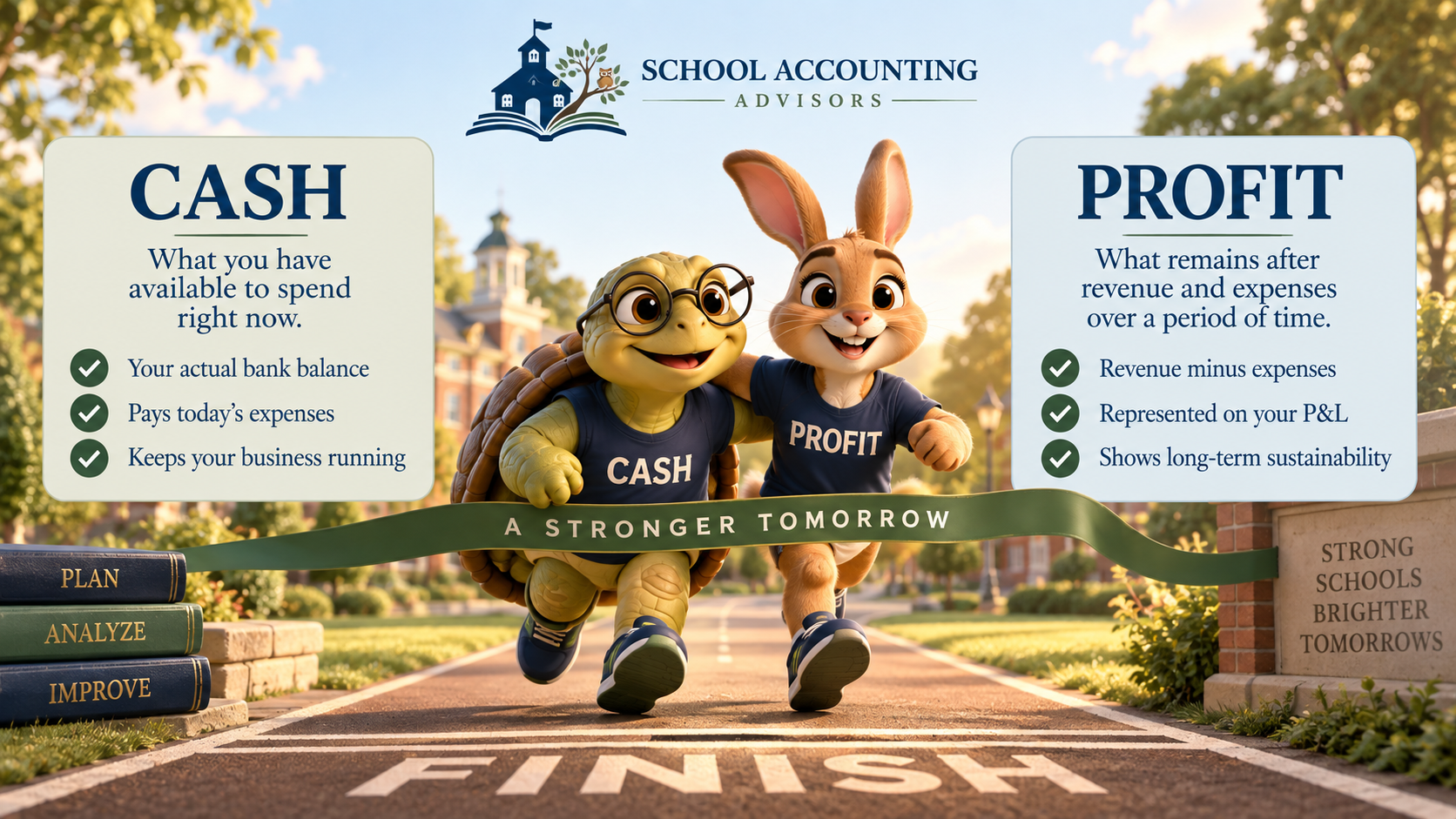
That's Why We Need Both Runners to Finish
Financial stability isn't about choosing cash or profit. It's about understanding what each one is telling you. Cash gives your school the ability to survive the unexpected. Profit gives it the ability to sustain itself over the long term. And when we forecast both, we gain something even more valuable:
Time.
If I can show you that your childcare center is likely to have a cash problem five months from now, we have five months to work on it. We can examine expenses, look at collections, model tuition, evaluate staffing, and consider financing before we're desperate for it. We have the ability to make thoughtful decisions instead of emergency decisions.
That's what I want your financial information to do for you. Accounting shouldn't simply tell you what happened last month. Your numbers should help you decide what to do next.
Are Cash and Profit Running Together in Your School?
If you're looking at your financial statements and thinking:
"We're profitable, so why don't we have any money?"
—or—
"We have money in the bank, but I don't know whether we're actually making money."
Those are questions worth answering.
At School Accounting Advisors, we help childcare centers and independent schools understand the story behind their numbers through accounting, cash-flow forecasting, financial modeling and advisory services. If you are struggling with profit, cash, or both; book a free consult with us to talk about your numbers.
Like knowing what your numbers are actually trying to tell you?
Join School Finance Insights for practical financial guidance created for childcare centers and independent schools.
No accounting degree required. We promise.