
How Much Cash Should Your School Keep in Reserve?
A cash reserve gives your school more than protection from emergencies. It gives you time, options, and the ability to make thoughtful decisions instead of desperate ones.
Your childcare center has money in the bank. But is it enough? That's a very different question. A healthy bank balance today doesn't guarantee that you'll have enough cash when enrollment drops unexpectedly, a state reimbursement is delayed, an HVAC system fails, or payroll arrives before a major receivable does.
That's why I want school owners to think beyond simply having some money in the bank. I want you to have a cash reserve strategy. Because a cash reserve isn't just emergency money. It's time. And time gives you options.
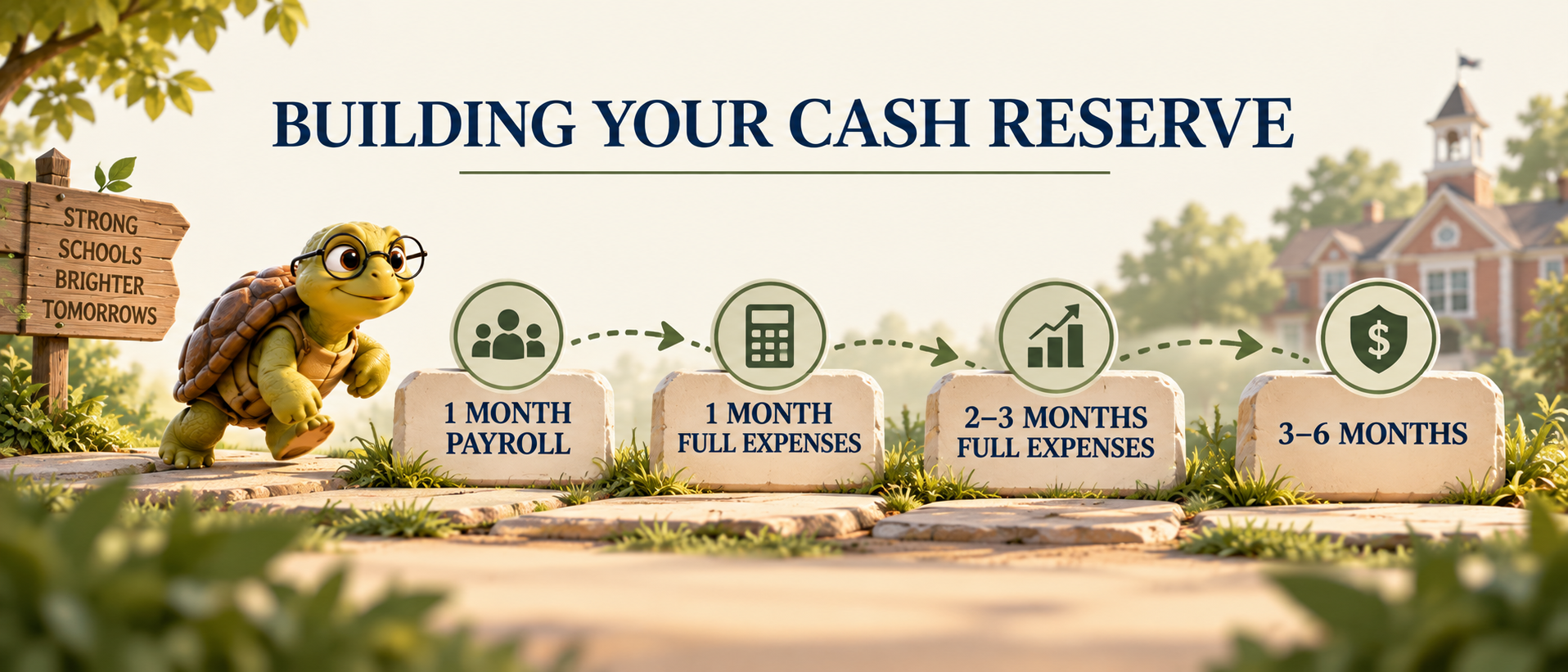
Start With One Month of Payroll
If you're starting from very little cash reserve, I don't want your first goal to be six months of expenses. That's overwhelming, so let’s start with something much more achievable:
One month of payroll in the bank.
Why payroll first? Because when cash gets tight, there are some expenses you may have a little flexibility with. You might be able to delay a purchase or negotiate payment terms with a vendor. Many of your expenses could temporarily go on a credit card (although I don't love that option because expensive debt can create an entirely new cash-flow problem in the future), but it would get you through the immediate crisis.
But payroll is different, it cannot be put on a credit card. You have to have cash in the bank account.
Your employees have worked and they need to be paid. From an ethical and a legal standpoint, it is extremely important to pay on time. And a school that can't make payroll has moved from a financial concern into a financial crisis. That's why I like one month of payroll as the first milestone.
It creates an initial layer of stability.
Then Build Toward One Month of Full Expenses
Once you have a month of payroll protected, don't stop. Your next goal is: One month of your full operating expenses.
That means you're no longer protecting only payroll. You're protecting the whole operation. Think about everything your center needs to keep functioning:
Rent or mortgage.
Utilities.
Insurance.
Food.
Curriculum and classroom supplies.
Software.
Administrative expenses.
Payroll.
Payroll taxes.
All of the other expenses that continue whether it's a great month or a difficult one.
Having one month's full expenses available means one unexpected event doesn't immediately force you into emergency mode. Now, if you foresee a financial crisis, you may still work to reduce those expenses, but having the cash buys you time.
Then Work Toward Two to Three Months
Once you've built one month of full expenses, the next target is: Two to three months of full operating expenses.
This is where your cash reserve starts doing something very important. It gives you runway. Most schools experience some (or all of the following at various times: enrollment drops, government funding changes, reimbursements slow down, you lose a large contract., or you discover that your pricing, staffing or enrollment model needs to change. Those problems often cannot be solved overnight.
If you have almost no cash reserve, you may know exactly what the right long-term decision is and still not have enough time to implement it. A stronger reserve changes that. And if you don’t know the right decision, it gives you time to get the right data, call the right experts to help form a plan and time to implement the plan.
Cash Reserves Buy You Time to Make Better Decisions
I worked with a school that faced a significant change in state funding. We identified the problem and developed a plan to address it, but the owner didn't want to make every change immediately. She wanted to make the transition at a pace that was healthier for her families and less disruptive to the school. Because she had a strong cash cushion, she could.
She was able to sustain approximately six months of losses while we implemented the plan. While that cash didn't fix the underlying problem. It gave us time to identify and fix the underlying problem in a way that fit her values.
And that is one of the most important things a cash reserve can do for a school. Your reserve doesn't simply protect you from disaster. It gives you the ability to make decisions based on what's best for the organization rather than what's necessary to survive Friday.
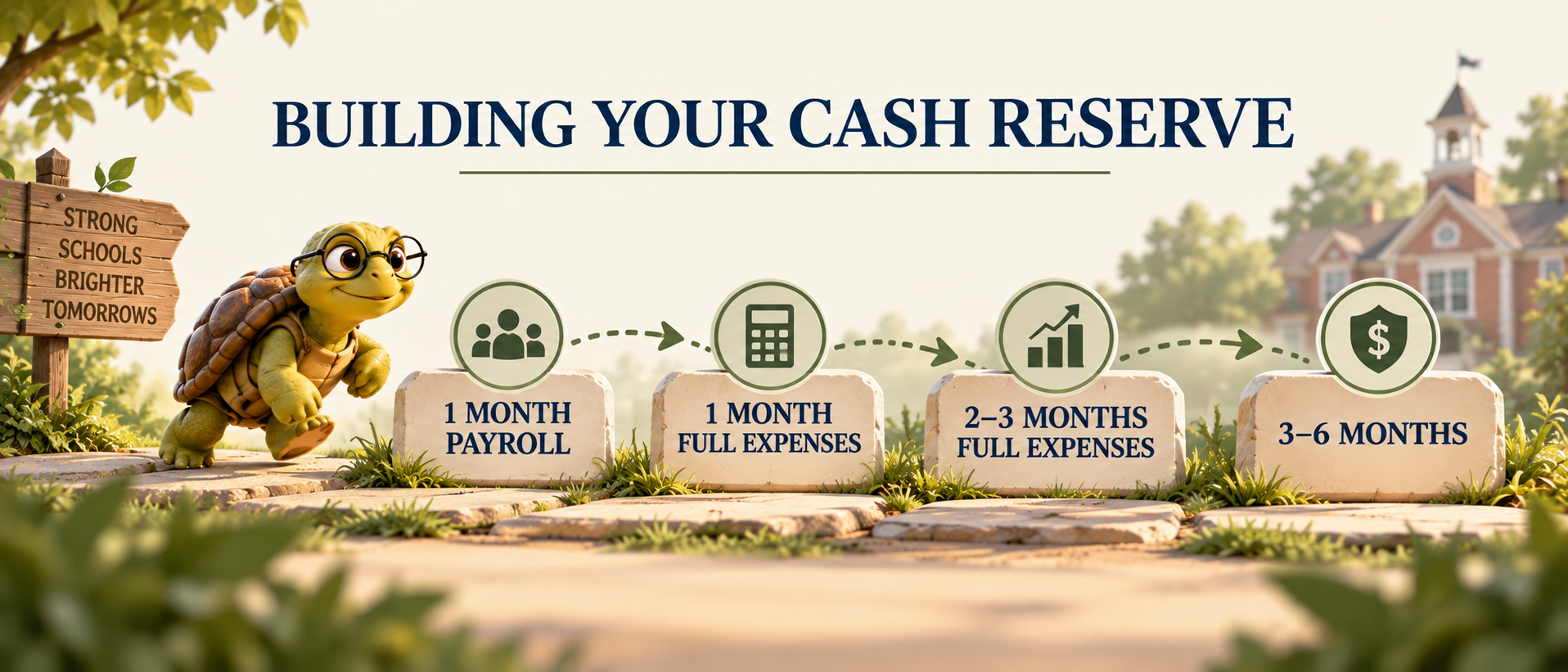
And Eventually? I'd Love to See Three to Six Months
For a mature, financially stable organization, I love to see a longer runway. Three to six months of operating expenses is an excellent long-term goal. That doesn't mean every childcare center needs six months sitting in the bank tomorrow. And I definitely don't want an owner to hear “six months of expenses” and conclude that because that number feels impossible, there's no point in starting.
There is. Build it in stages.
First payroll. Then one month. Then two. Then three.
And keep evaluating what makes sense for your particular organization. A center with highly predictable private-pay tuition may face different risks from one heavily dependent on government reimbursements. A single-location school may have different needs from an owner operating several centers. The exact number is less important than having an intentional plan instead of simply hoping the balance grows.
Before You Build the Reserve, Make Sure You're Collecting What You're Owed
There's another piece of cash management that sounds simple but can create enormous problems:
Collect your receivables.
If families owe you tuition, that money isn't helping your school operate while it sits in accounts receivable. I once worked with a client who was falling $30,000 to $40,000 behind in tuition collections. At that point, it becomes difficult even to understand what is happening financially.
Do we have a pricing problem?
An enrollment problem?
A profitability problem?
Or are we simply not collecting the revenue we've already earned?
Those are very different problems requiring very different solutions. You can create consistent systems for invoicing families and following up on past-due balances.
Similarly, you can't necessarily control when a government program sends payment. Some of the organizations in charge of distributing these payments do not pay on a predictable or consistent schedule. I know this is very frustrating for you. But you can control whether your paperwork is submitted accurately and on time, and you can have a contingency plan in place for what to do if they are late. If this is a situation your school is at risk for, you need to know how long you can sustain operations if the payment is late, and what options you have to make adjustments (such as loans, changing spending etc).
A Cash Reserve Doesn't Replace Profitability
This distinction is important. If you are confused about the difference between cah and profitability, see the blog Your School is Profitable. So Why Is There No Money in the Bank? It will help you understand the difference between cash and profit and why both are so important.
But nor now, just know that a cash reserve gives an organization time, but it doesn't make an unprofitable organization profitable. If your center consistently spends more money than it earns, you can have $200,000 sitting in the bank and still have a problem. You'll simply take longer to run out of money.
Once the immediate cash problem is stabilized, we have to ask: Is the underlying business actually profitable? If the answer is no, then we need to work on the economics of the center. That may mean looking at enrollment and capacity. It may mean looking at tuition. It may mean looking at staffing and compensation. It may mean looking at several of those together. But cash reserves give us something incredibly valuable while we work through those questions:
Time to think.
Don't Just Save Cash. Forecast It.
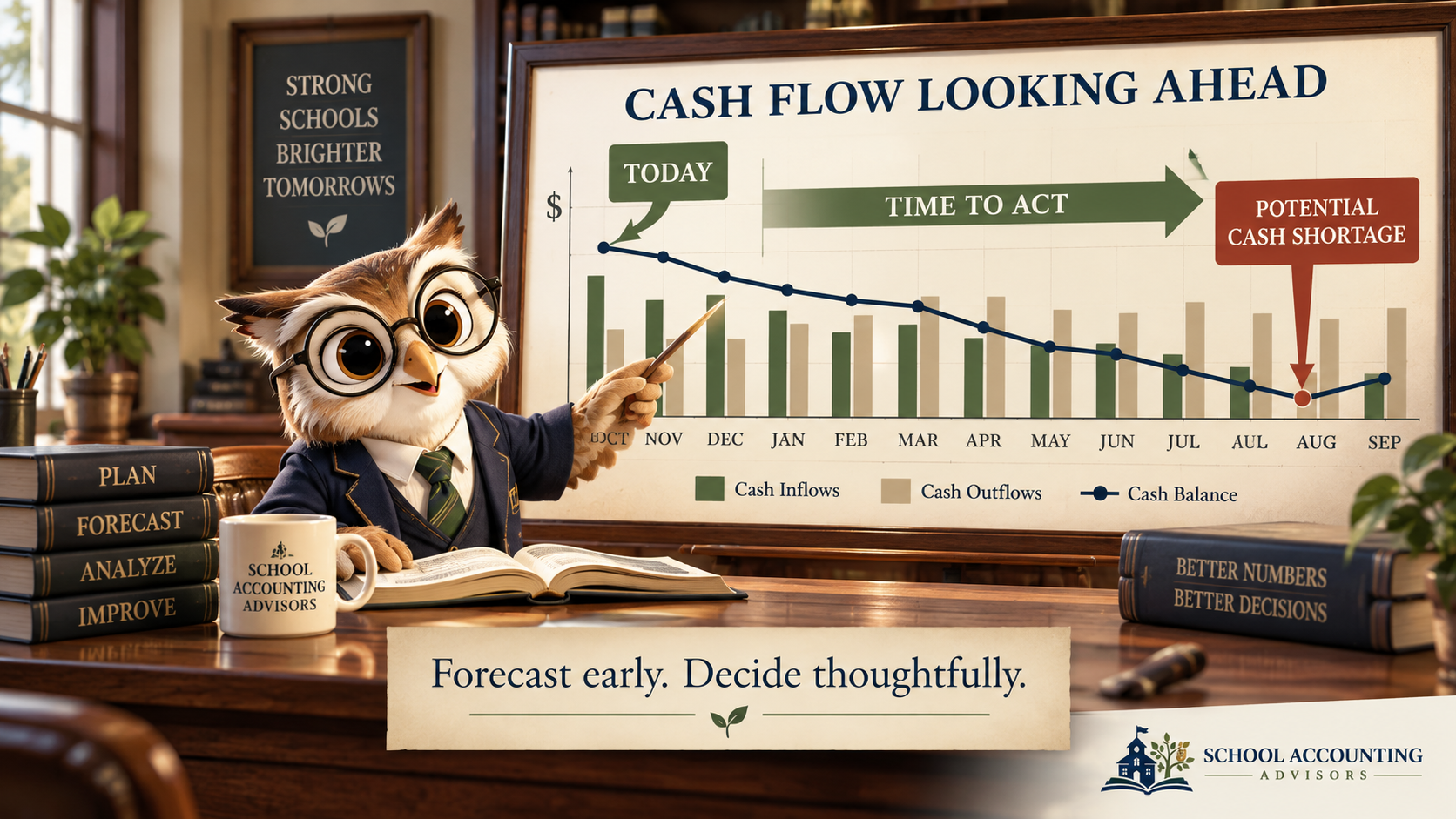
Building a reserve is only half of the strategy. The other half is knowing what's coming. A business can have a healthy reserve and still be surprised by a cash crunch if no one is looking forward. That's why one of the most useful financial tools for a childcare center is a cash-flow forecast.
A good forecast asks:
What's coming into the bank?
When will it arrive?
What's going out?
When will it leave?
Are there months when our normal inflows and outflows don't line up?
And most importantly:
How much time do we have before there's a problem?
When I became the administrator of a school, that was one of the most important things the numbers told me. We weren't in a cash crisis that day. But when I did the cash projection, I could see one coming several months ahead. Knowing early gave us far more options, we did the following:
Controlled expenses by delaying any unnecessary purchases and hiring
Prepared financing as a backup
Gave parents the option of prepaying tuition for a discount
Five months of notice gives you five months to solve a problem. Five days of notice gives you five days. That's why accounting shouldn't only report what happened last month. Good financial information should help you see what's likely to happen next.
I will be creating a tutorial on how to build a cash forecast specifically for schools. Until then you can use this video which shows how to make generic one. If this feel overwhelming to create, reach out to your accountant and see if they can help. Cash flow projections are one the analyses we offer to all of our clients at School Accounting Advisors.
What If You're Already in a Cash Crunch?
If cash is already dangerously low, your priorities change. You need to know exactly what is available, what is coming in, and what has to go out first. That may mean monitoring cash daily, following up on receivables, cutting nonessential spending, and being very cautious about short-term financing. Those are crisis-management decisions, and they deserve their own discussion.
In Blog #3, we'll walk through what to do when a cash-flow crisis has already arrived—and how to stabilize the situation without creating a bigger problem.
The bigger goal, though, is to build enough cash reserve that every financial problem does not become an emergency.
Your Cash Reserve Is Really an Options Fund
I think the phrase emergency fund is sometimes too narrow. Yes, your reserve protects you when something goes wrong. But it also gives you choices. It can give you time to weather a delayed reimbursement, replace something unexpected, adjust staffing thoughtfully, or phase in a difficult change without making every decision based on what produces cash fastest. That's why I don't just want schools to build an emergency fund.
I want them to build options.
A strong cash reserve gives you the ability to make thoughtful decisions instead of desperate ones.

How Much Runway Does Your School Have?
Here's the question I'd leave you with: If revenue slowed tomorrow, how long could your school continue operating without borrowing money?
A week? One payroll? One month? Three months?
You don't have to be at your ideal reserve today. But you do need to know where you are. Then start building. Set a goal of one month of payroll. Then build toward one month of full expenses. Then two to three months.
Over time, work toward the level of reserve that gives your particular school enough stability and decision-making time to respond well when something changes. That step-by-step progression is the reserve strategy you outlined in your presentation.
And keep forecasting.
Because the goal isn't simply to have more money sitting in the bank.
The goal is to know what's coming—and have enough time and cash to make a good decision when it does.
Better Numbers. Better Decisions. Stronger Schools.
At School Accounting Advisors, we help childcare centers and independent schools understand their numbers, forecast cash needs, model financial decisions and build plans for stronger long-term financial health.
If you're not sure how much cash your school should have—or whether you're on track to get there—we can help you figure out what the numbers are telling you. Book a free consult with us!
Fewer financial surprises would be nice, wouldn't they?
Join School Finance Insights for practical strategies to help you understand what’s happening with your school’s money before it becomes an emergency.
Because your bank balance should not be the most suspenseful part of your week.