
Discounts can be a great business decision. They can also quietly become a very expensive habit. The difference is knowing what you're giving up—and what you're getting in return.
Most school owners know their tuition rates.
Ask what you charge for an infant, toddler, preschooler, or elementary student, and you can probably answer pretty quickly. You may have spent an unreasonable amount of time deciding whether your last tuition increase should be 5% or 6%, because apparently one percentage point becomes considerably more intimidating when you have to put it in a letter and send it to 100 families.
But here's the number I find more interesting: How much of that tuition are you actually collecting? For most schools, the rate on your tuition sheet and the amount your school actually collects can be two very different numbers.
There's the sibling discount. The employee discount. Scholarships. Maybe a military discount. A promotional rate you offered to fill a classroom. The family who has been with you forever and somehow survived the last four tuition increases completely untouched. And then there's usually at least one discount that exists because somebody made a decision several years ago, nobody remembers exactly why, and everyone has collectively decided it would be easier not to ask.
None of those things is automatically a problem.
But put them all together, and we may discover that the tuition rate on your rate sheet bears only a passing resemblance to the tuition revenue showing up on your P&L. That is something I want to know.
“But It's Only 10%.”
This is where percentages get sneaky.
Let's say your published tuition is $300 per week and you offer a 10% sibling discount. That's $30.
Thirty dollars doesn't sound particularly alarming. Nobody is calling an emergency meeting. Ledger has not yet opened an investigation. But let's follow the $30. Over 50 weeks, that discount is $1,500 for one child. If 12 children receive the same discount, we're now talking about:
$30 × 50 weeks × 12 children = $18,000
Same 10%. Very different feeling.
Now, before anyone thinks I'm coming for every sibling discount in America, I'm not. That $18,000 may be money very well spent. Maybe the discount helps you enroll siblings who otherwise would have gone somewhere else. Maybe those families stay longer. Maybe it makes your school more competitive. Great! But let’s make sure we know what that discount is actually costing us first.
And then let's call it what it is: You invested $18,000 in a pricing strategy designed to attract and retain families. Was it worth $18,000?
Maybe.
But let's actually ask.

Let's Calculate Your Discount Rate
Fortunately, this is one of the easier numbers I want school owners to calculate. No complicated financial model required. Ledger can leave the advanced calculator in the drawer.
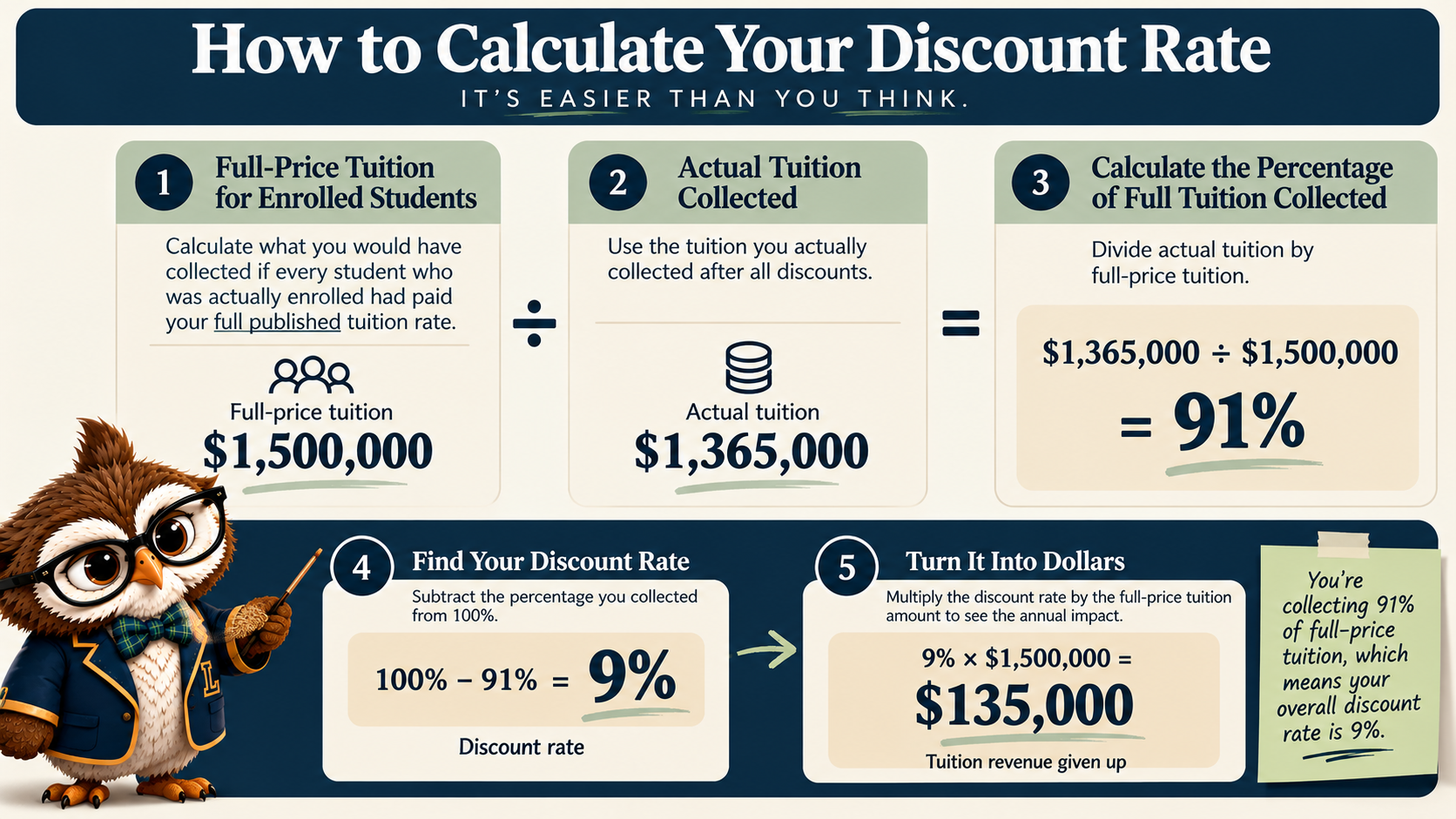
You need two numbers: the tuition you actually collected and the tuition you would have collected if every student who was actually enrolled had paid your full published tuition rate.
Then divide:
Actual Tuition Collected ÷ Full-Price Tuition for Actual Enrollment = Percentage of Full Tuition Collected
Let's say the students enrolled in your school would have generated $1,500,000 if everyone paid the full published rate.
After employee discounts, sibling discounts, scholarships, grandfathered rates and everything else, you actually collected $1,365,000.
So:
$1,365,000 ÷ $1,500,000 = 91%
You're collecting 91% of full-price tuition, which means your overall:
Discount Rate = 9%
In dollars, that 9% represents: $135,000
Notice that I said enrolled students. We're not calculating what you could have collected if every licensed seat in the building were full. Empty seats are an enrollment issue, not a discount issue, and I don't want to blame the wrong suspect.
Now, a 9% discount rate may not sound particularly alarming.
But $135,000?
I'm guessing I have your attention.
That doesn't mean the school made $135,000 in bad decisions. It means we have $135,000 worth of decisions to understand.
And that's where the analysis gets interesting.
Not Every Discount Is Guilty
A discount is really a decision to give up tuition revenue in exchange for something else you value. A sibling discount may help you enroll and retain an entire family. A scholarship may be an intentional part of your school's mission. A promotional rate might fill an otherwise empty seat without requiring additional staffing.
Those can all be reasonable decisions.
What I want to know is whether the discount is accomplishing its purpose. If we're giving up $20,000 a year in sibling discounts because we believe they improve enrollment and family retention, let's see whether that's happening. If we're providing $30,000 in scholarships because accessibility is part of our mission, wonderful. Let's make sure we've budgeted for it.
Generosity deserves a budget too.
And if we're offering a discount simply because we've always offered it, perhaps it's time to revisit the decision. Which brings me to one discount I particularly want school owners to examine.
Before You Give an Employee Discount, Check for Assistance
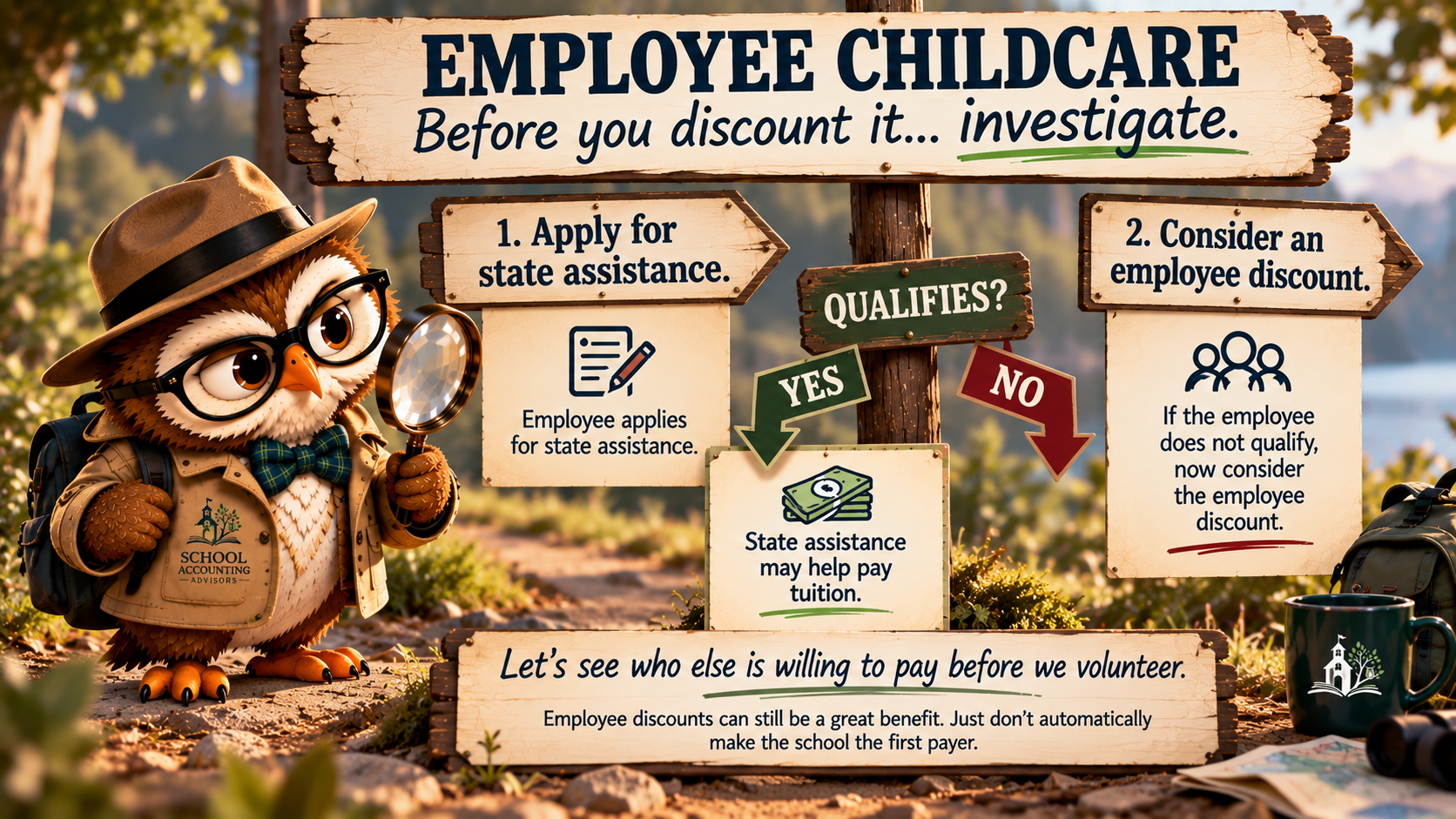
Employee childcare discounts can be a fantastic benefit. They may help you recruit and retain excellent teachers, and in an industry where staffing is already challenging, that's worth something. But before you automatically discount an employee's tuition, I want you to encourage that employee to check whether they qualify for state childcare assistance.
Seriously! You may be giving away tuition revenue that another funding source could help pay.
State childcare subsidy programs can help eligible working families pay for childcare. Eligibility and reimbursement rules vary by state, so this isn't something the school should try to determine itself. Point employees toward the appropriate state program and encourage them to apply.
If they qualify and your school participates in the program, you may be able to receive subsidy funding toward that child's care rather than financing the entire employee benefit through a tuition discount.
And if they don't qualify? You can still give them the discount.
I'm not suggesting taking away a valuable employee benefit. I'm suggesting we check for available funding before deciding how much of that benefit the school needs to pay for itself.
If an employee's childcare costs $12,000 annually and the school automatically gives a 50% discount, that's $6,000 in tuition revenue the school has chosen to give up. If the employee can qualify for assistance that helps cover the child's tuition instead, the employee still receives affordable childcare while the school may collect substantially more revenue.
The employee gets help with childcare. The school preserves more tuition revenue. And you still have a valuable recruiting and retention benefit.
I like it when the math works for everyone.
Just remember that subsidy, parent copayment and additional-charge rules vary by state. The goal is not to stack discounts creatively until we accidentally invent a new compliance problem. Check the applicable program rules first.
And Then There Are the Grandfathered Rates
Ah, yes.
The tuition discount that was supposed to be temporary. A family enrolled several years ago, and for a perfectly reasonable reason at the time, you decided not to include them in a tuition increase. Then another tuition increase happened……. And another. At some point, the temporary exception quietly applied for permanent residency.
Meanwhile, wages increased. Insurance increased. Food increased. Supplies increased. Pretty much everything involved in operating the school became more expensive. The old tuition rate, however, remains deeply committed to tradition. This doesn't mean you should never grandfather a rate. Sometimes easing existing families into a larger tuition increase makes perfect sense.
What I don't love is a discount with no end date and no review date.
If you offer promotional pricing, decide when it expires. If you're grandfathering existing families, decide when you'll review it. If you have a partnership discount, revisit it periodically. Otherwise, temporary pricing has a remarkable ability to become a treasured family heirloom.

Before You Raise Tuition, Look at What You're Already Collecting
Suppose your school needs additional revenue. Payroll, insurance, food and facility costs have increased, and your cost-of-care model tells us tuition isn't producing the margin the school needs. The obvious answer may be to raise tuition. Sometimes that is exactly the right answer. But before we increase the number on the tuition sheet, I want to know how much of the current number we're actually collecting.
If published tuition has kept pace with costs but your discount rate has gradually increased from 4% to 6% to 9%, that tells me something. Perhaps you're using discounts strategically to fill classrooms. Maybe more employees are enrolling their children. Maybe you've expanded scholarships intentionally. Or perhaps discounts have just been quietly multiplying when nobody was looking.
I'd rather model our choices than automatically raise tuition again. What happens if eligible employees use state assistance before we apply an employee discount? What happens if we change the sibling discount? What happens if existing families keep grandfathered rates through the end of the school year but transition afterward?
And what happens to enrollment under each scenario?
That's what financial modeling is for.
We get to make the bad ideas fail in Excel first. Excel is considerably less likely to leave us a one-star Google review.
Your Assignment: Investigate the Discounts
Pull your enrollment and billing information. Calculate what the students who were actually enrolled would have paid at full tuition and compare it with what you actually collected.
There's your discount rate.
Then turn the percentage into dollars.
Next, break that difference into categories: employee childcare, sibling discounts, scholarships, grandfathered rates, promotional pricing, and anything else that applies to your school.
And yes, “I have no idea why they're paying this amount” is absolutely allowed to be a category.
For each one, ask: Why do we offer it? What does it cost us annually? What are we receiving in return? Is it accomplishing its purpose? Could another funding source cover some of the cost? Does it have an expiration or review date?
And perhaps the most revealing question:
Would we create this same discount today?
Sometimes the answer will be absolutely yes. Great. Keep it! Mission is REALLY important.
Sometimes the answer will be yes, but we'd structure it differently.
And occasionally: “Wait. We're still doing that?”
That is why we did the audit.
The Goal Isn't Zero Discounts
I don't want you finishing this article thinking I'm coming for your sibling discount, employee childcare benefit or scholarship program. I'm not.
The goal isn't zero discounts. The goal is zero mystery discounts.
If an employee childcare benefit helps you retain excellent teachers, let's keep it working—but let's also check whether another funding source can help pay the tuition before the school automatically absorbs the entire cost. If scholarships are central to your mission, let's budget for them. If sibling discounts help you enroll and retain families, let's measure whether they're accomplishing that goal.
And if a discount has been quietly sitting on an invoice for seven years because nobody remembers why it exists? Ledger has the magnifying glass. Know what you're giving up. Know why you're giving it up. Know what you're getting in return.
That's not being stingy. That's managing the school.

Better Numbers. Better Decisions. Stronger Schools.
At School Accounting Advisors, I help childcare centers and independent schools understand what their numbers are actually telling them. Sometimes the problem is cash. Sometimes it's enrollment, tuition or staffing.
And sometimes the revenue mystery has been sitting right there on the invoices the entire time. BOOK A FREE CONSULT →