
Your School Isn’t Profitable Enough. Now What?
Enrollment. Tuition. Staffing. When profitability isn't where it should be, the answer usually isn't “cut everything.” It's figuring out which part of the business model isn't carrying its weight.
You made it through the cash crunch. Payroll cleared. The lights are still on. Nobody had to sell the playground equipment on Facebook Marketplace. Excellent! Now we need to talk about the slightly less dramatic—but considerably more important—question: Is your school actually profitable?
Because solving a cash shortage and solving a profitability problem are not the same thing. You can borrow money, collect overdue tuition, delay a purchase, or negotiate a payment and improve cash temporarily. But if your school consistently spends more than it earns, eventually you run out of creative places to find cash.
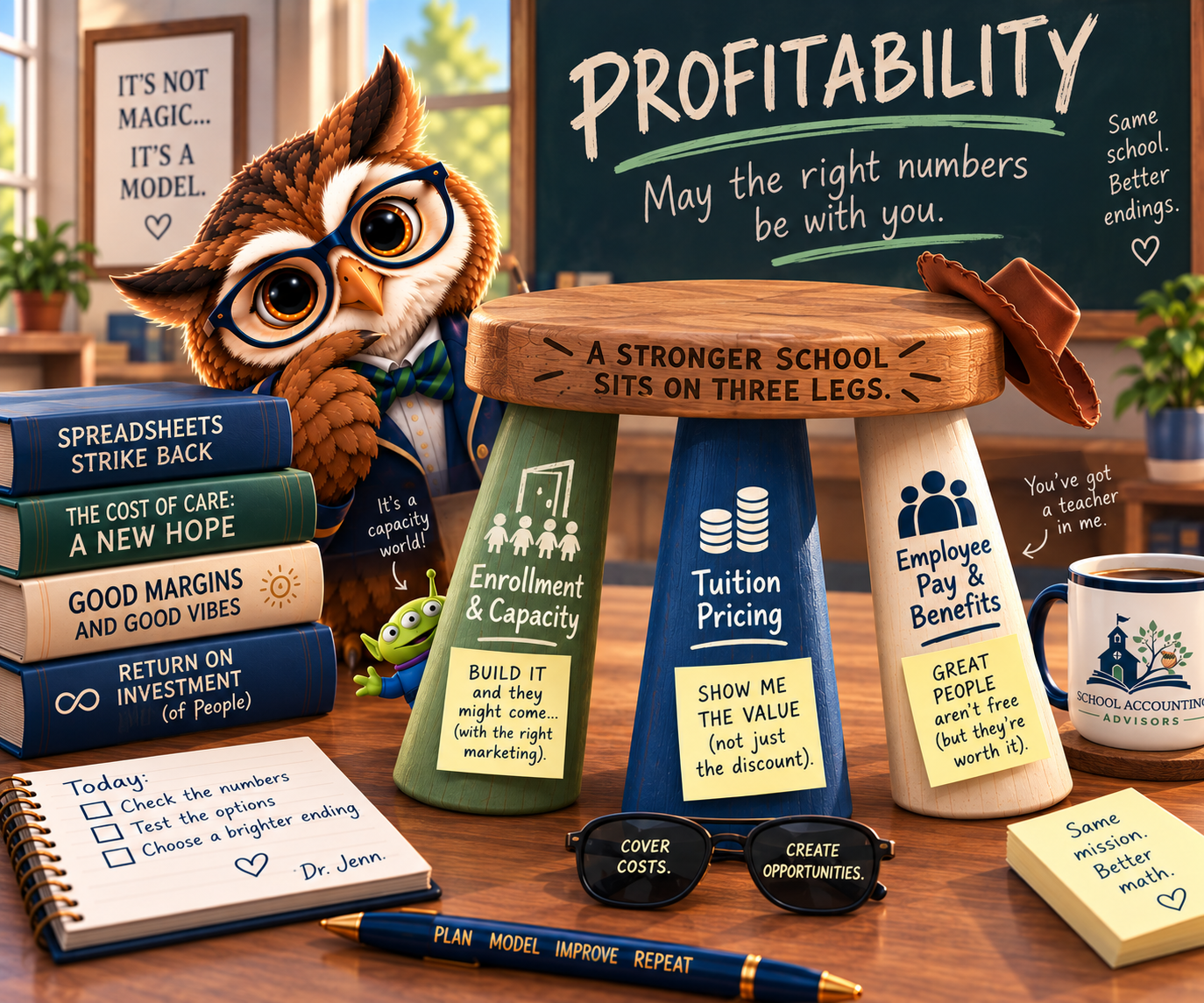
There are, unfortunately, only so many couch cushions under which to find change. So, once cash is stable (or maybe even before), we need to look at the underlying economics of the school. And when I work with school owners on profitability, I think about it as a three-legged stool:
Enrollment & Capacity. Tuition Pricing. Employee Pay & Benefits.
The frustrating part is that we usually want all three legs to do things that don't naturally coexist.
We want smaller ratios. We want affordable tuition. We want excellent employee pay and benefits.
I want those things too.
The math, however, has declined to become emotionally invested in our preferences.
Those three pieces have to balance. If they don't, the stool eventually tips over. That's the basic profitability framework I use when I start digging into a school's numbers.
Leg #1: Enrollment & Classroom Capacity
The first question is not simply:
How many children are enrolled?
The better question is:
How efficiently are we using the capacity we already have?
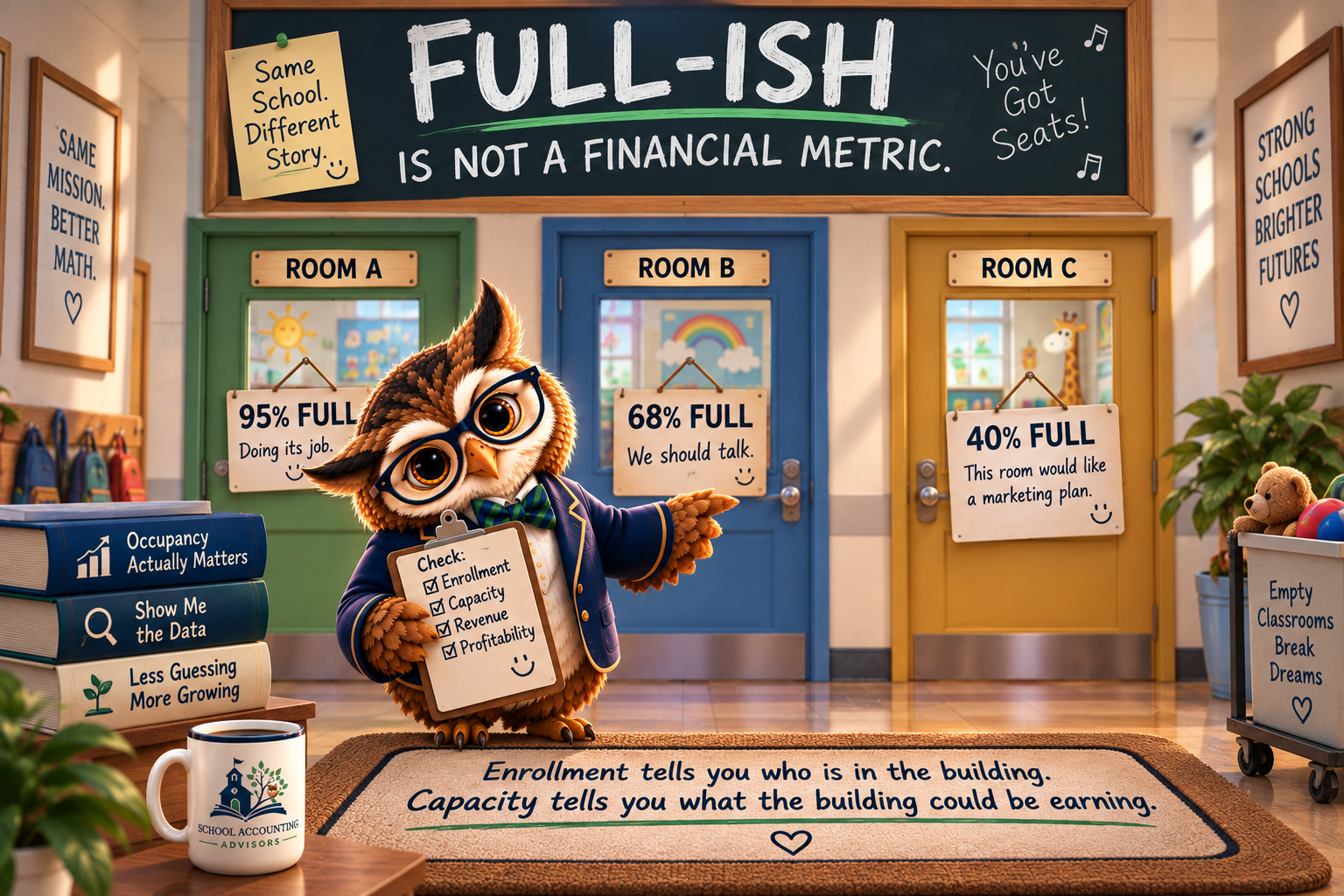
Imagine two schools that each have 100 enrolled children. One has space for 105. The other has space for 160.
Those are very different financial pictures.
A classroom carries certain costs whether every available seat is filled or not. You still need the space. You still have utilities. You still need teachers to maintain ratios. Your director still expects a paycheck even though three children decided not to enroll in the Blue Room.
This is where HINGE Early Education Advisors has a particularly useful way of looking at occupancy. They point out that simply dividing enrollment by licensed capacity can be misleading because part-time enrollment, discounts, and operating choices can distort the financial picture. Their alternative financial-health calculation uses net revenue, average tuition and licensed capacity to look at how effectively capacity is actually producing revenue. HINGE uses 70% or greater as its baseline financial-health benchmark, while also emphasizing that individual decisions about capacity should be made intentionally.
If you want to dig into that calculation before I do a deeper treatment of occupancy and classroom economics here at School Finance Insights, HINGE's explanation is worth reading: How to Calculate Occupancy Percentage for Your School — HINGE Advisors
And there is an important idea underneath all of this: A school can look full and still have an enrollment problem.
Maybe one classroom is overflowing while another has six empty seats. Maybe your preschool rooms are performing beautifully but your infant program loses money. Maybe your overall enrollment percentage sounds respectable, but the revenue generated by those enrollments doesn't support the staff and facilities required to serve them. Those details matter.
Sometimes one more child changes the math. Sometimes it doesn't.
Ratios matter here too.
Suppose an infant classroom can legally accommodate five children, but adding the fifth infant requires another staff member. That fifth enrollment brings additional tuition—but it may also trigger enough additional labor cost that the classroom becomes less profitable. That's why I don't love financial advice that starts with: “You just need more enrollment.”
Maybe.
Let's do the math first. A good model lets us ask: What happens at four children? What happens at five? What happens when we add the teacher? Where does this classroom actually become profitable?
That is much more useful than assuming: More children = more profit. In a future presentation, I will show you how to model it so you can be sure.
And if enrollment really is the problem?
Then accounting can tell us how many seats we need to fill. It cannot, by itself, make families appear.
This is one place where Child Care Business Growth has some useful material. Their recent discussion of business scorecards recommends working backward from a target occupancy: determine how many enrollments are needed, then how many tours are required to produce those enrollments, and finally how many leads are needed to generate those tours. That turns “we need more enrollment” into an actual measurable plan.
Marketing and enrollment strategy deserve their own discussion rather than turning this article into an accounting-marketing-parent-tour epic. In the meantime, their explanation of reverse-engineering enrollment growth is a helpful next step if your numbers tell you capacity is the wobbly leg: Know Your Numbers Before You Scale — Child Care Business Growth
Leg #2: Tuition Pricing
This is usually everyone's favorite conversation. By “favorite,” I mean everyone suddenly becomes extremely interested in discussing literally anything else.
School owners care about their families. They know childcare and private education are expensive. They don't want to price families out, and many owners entered education because they genuinely want to serve their communities. That is important and there is still a difference between wanting tuition to remain accessible and setting tuition at a level that cannot support the service you're promising to provide.
Your tuition has to pay for the actual cost of operating your school. Not the cost from three years ago. Not what you wish it cost. And not whatever the school down the street happens to charge. Your actual cost.
This is another area where I think HINGE's material is genuinely useful. Their guidance on tuition pricing makes two points I strongly agree with: know what comparable schools charge, but don't let a competitor's price determine yours; and calculate the actual cost of providing the care you want to provide, including enough margin to reinvest in the school.
You can read their discussion here: The True Cost of Care: Setting Your Preschool Tuition Rates — HINGE Advisors
This is where a cost-of-care analysis becomes extremely useful. One of the first things I want to know is your break-even enrollment.
How many children do you need before the school stops losing money?
Then I want to model the other end. If the school reaches its desired maximum enrollment, how profitable is it? That question can expose a tuition problem very quickly. I've worked with a center where we ran the numbers and discovered that even at maximum enrollment, the school still wouldn't break even.
At that point, we do not have an enrollment problem. We have a pricing or cost-structure conversation waiting for us. And waiting longer will not make it less awkward.
“But My Families Can't Afford a Big Tuition Increase.”
Maybe they can't. That's why modeling is so useful. Financial modeling isn't supposed to produce one giant spreadsheet that announces: RAISE TUITION 17%. GOOD LUCK.
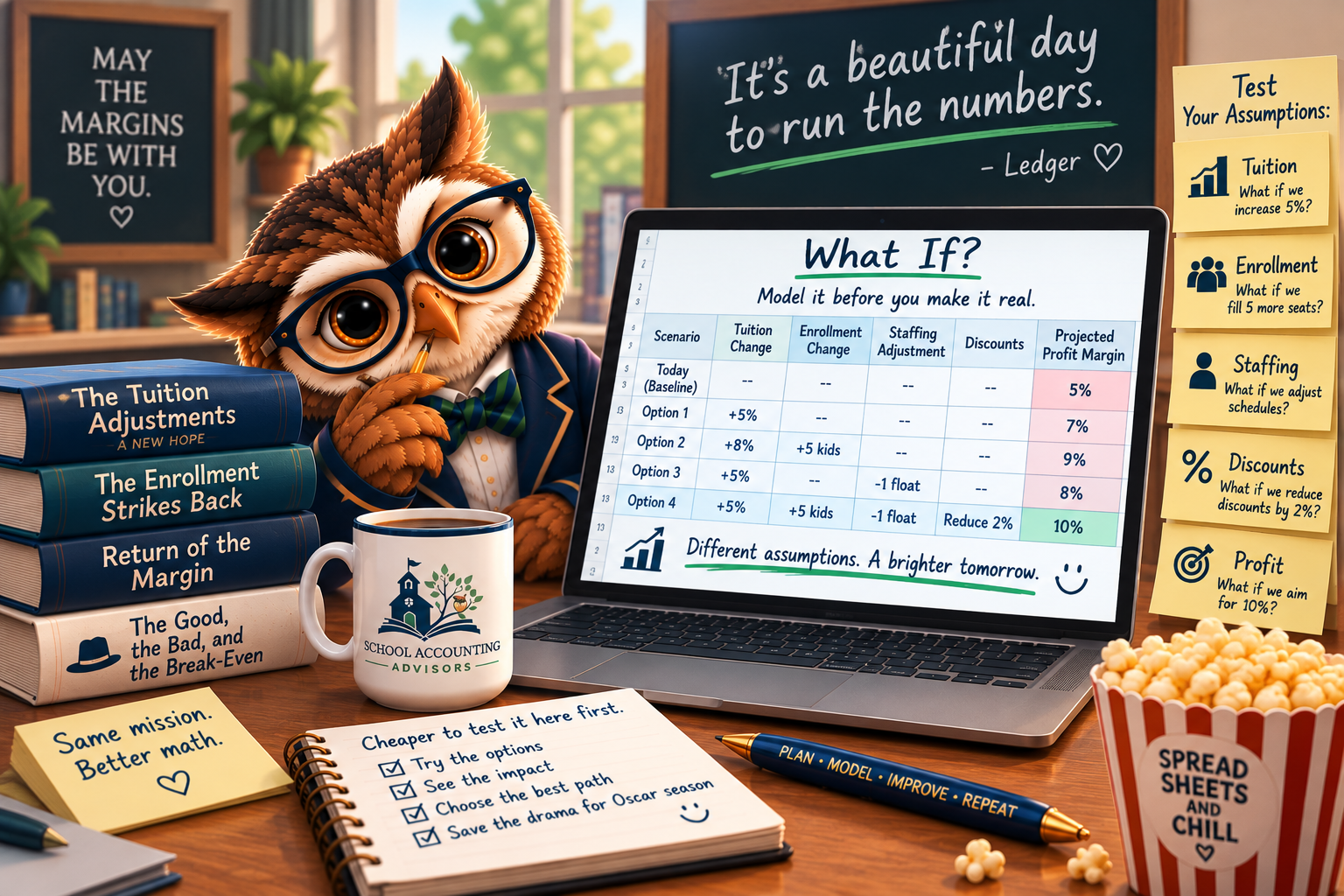
It allows us to test possibilities before implementing them. Suppose you're currently projecting a 5% profit margin, but you'd like to reach 10%. We can model what tuition increase would get you there. Then we ask whether that increase is realistic for your families and your market.
If it isn't, we don't throw away the spreadsheet and accept defeat. We change another assumption. What if enrollment increases? What if we adjust staffing? What if we change a discount? What if we make a smaller tuition adjustment and combine it with another operational change?
That's one of the most important benefits of modeling: we can make the spreadsheet suffer through all of our ideas before we make families or employees suffer through them.
The goal isn't to force your school into a generic accounting formula. The goal is to understand the trade-offs well enough to find a solution that works financially and fits the values of your school. That's the approach I described in the original presentation: model the options, understand the compromises, and find the combination the owner can actually live with.
Before Raising Tuition, Look at What You're Actually Collecting
Here's another sneaky one. Your published tuition rate and your actual tuition revenue are not necessarily the same thing.
Perhaps you offer sibling discounts. Employee discounts. Legacy rates. Scholarships. Promotional discounts. A special rate for that family who's been with you forever. And possibly one discount whose origin has been lost to history but everyone is now afraid to touch it.
Individually, each one may seem reasonable. Collectively? They can quietly turn a perfectly reasonable tuition schedule into something very different. That's why I like to calculate the difference between what your enrolled families would generate at full tuition and what the school is actually bringing in.
I don't think the lesson here is: “Completely stop giving discounts.”
The lesson is: Know exactly how much they cost you.
A staff childcare discount, for example, may be a very intentional recruiting and retention investment. That's different from a discount that continues indefinitely because nobody remembers why it exists.
A 10% discount does not sound particularly terrifying. Twenty small exceptions spread throughout the school can become considerably more interesting. This is why spreadsheets have trust issues.
Leg #3: Employee Pay & Benefits
And now we arrive at the hardest leg. For most schools, labor is one of the largest—often the largest—expenses, usually accounting for 50%-60% in a healthy school. It is often higher in a school that is loosing money.
But this isn't a normal expense category. We're talking about people. Your teachers are doing difficult, important work. You want to attract excellent employees, retain them, compensate them fairly, provide benefits where possible, and create a workplace where good people actually want to stay.
At the same time, payroll has to fit inside the revenue the school generates. Those two things have to be true at the same time.
HINGE's work on childcare labor costs is useful here because it connects staffing costs directly to occupancy rather than treating “labor percentage” as an isolated number. Their benchmark model assumes schools need sufficient occupancy to spread fixed leadership and classroom staffing costs effectively, and they recommend looking at total staff costs—not just hourly wages—including payroll taxes, benefits, training and other employee costs.
Their labor-cost discussion is worth reading if this is the leg your numbers point toward: Controlling Childcare Labor Costs — HINGE Advisors
Notice what that doesn't mean. It doesn't mean: “Your teachers cost too much.”
The better questions are:
Are we staffing efficiently for our actual enrollment?
Are classrooms scheduled appropriately?
Are we carrying labor for capacity that isn't being used?
Would increasing enrollment make our current staffing level sustainable?
Does our tuition support the wages and benefits we want to provide?
Could fifteen minutes of scheduling efficiency matter more than cutting a benefit our teachers actually value?
Those questions treat staffing as part of a system, rather than treating employees as a problem to be cut. And that's exactly what the three-legged stool is meant to show.
You Can't Optimize All Three Independently
This is the part I want school owners to really understand. You can't decide what you want for enrollment, then independently decide what you want for tuition, and then independently decide what you want for compensation—and simply assume the numbers will cooperate.
They're connected. If you deliberately maintain very low student-to-teacher ratios, that's a legitimate educational decision. But something else in the model has to support it. Maybe tuition needs to be higher. Maybe enrollment needs to be extremely consistent. Maybe the school accepts a lower profit margin because that aligns with the owner's goals.
Likewise, perhaps keeping tuition particularly accessible is central to your mission. Fine. Then we need to understand what that choice requires from enrollment, staffing, outside funding, or expenses. This isn't about an accountant telling you what your values should be.
It's about knowing what your values cost.
Then you can make the decision intentionally. That's the difference between managing a business model and discovering one accidentally at the end of the year.
So How Do We Find the Wobbly Leg?
This is ultimately why I like cost-of-care and profitability modeling so much.
It turns a vague statement— “We aren't making enough money.”—into much more useful questions.
Is enrollment too low?
Are certain classrooms inefficient?
Is tuition below the actual cost of care?
Are discounts eating away at revenue?
Is labor too high for the enrollment and revenue currently supporting it?
What happens at break-even?
What happens at maximum enrollment?
What would have to change to move from a 5% margin to a 10% margin?
Those are questions we can work with. Sometimes the answer isn't one big change. It might be a small tuition adjustment, three additional enrollments, a change to discounting, and better alignment between staffing and classroom demand.
That's much less dramatic than: CUT COSTS.
It also tends to be considerably more useful.
I want to do a separate School Finance Insights article on building and interpreting a cost-of-care model because there is far more we can do with it than makes sense to cram into this post. Until then, HINGE's true-cost-of-care article above provides a useful introduction to why break-even and cost—not simply competitors' tuition rates—need to be part of the pricing conversation.
Once You Fix It, Keep Watching It
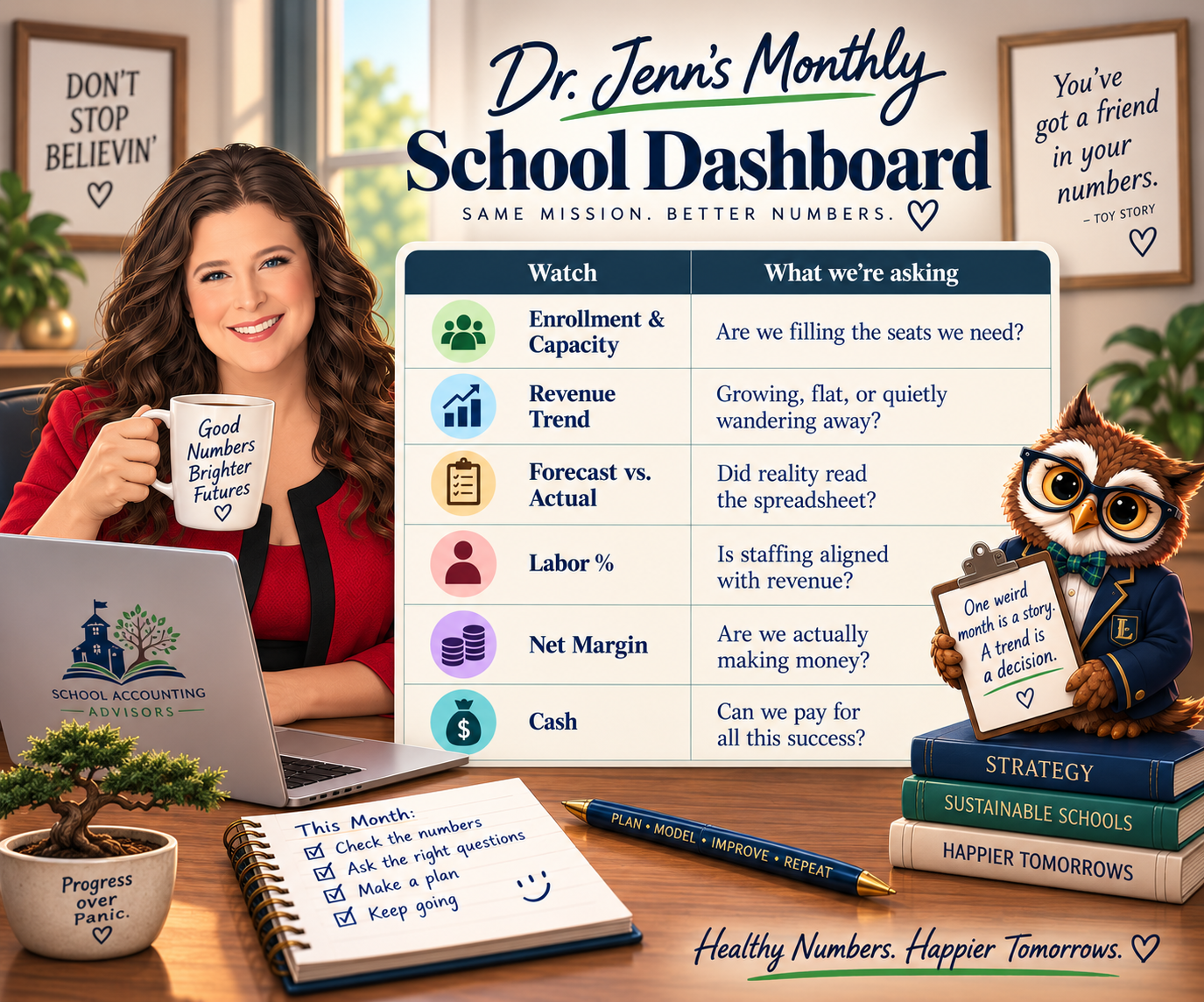
Profitability isn't something I want you to analyze once a year when your tax return is being prepared. By then, we're mostly doing financial archaeology. I want to monitor it while we can still do something about it.
That means comparing forecast to actual results. If we expected a certain level of revenue or profit this month and didn't get there, why? It isn't a punishment conversation. Maybe enrollment changed. Maybe an expense was unusual. Maybe tuition revenue came in below expectations. Maybe payroll was higher for a perfectly reasonable reason.
The question is simply: Are we on track?
And if not: Do we want to change something?
I also like watching the rolling average of revenue, so one unusually good or bad month doesn't distract us from the larger trend, along with net margin, forecast-to-actual results, enrollment, and key expense ratios. Those indicators help us notice changes early and tell us where to investigate first.
Child Care Business Growth makes a useful related point in its discussion of business scorecards: a number by itself isn't terribly useful until it has a target attached to it. “We're at 72% occupancy” is information. “We're at 72%, our target is 85%, and here is the plan for closing the gap” is management.
I'm going to go much deeper into which numbers I actually want school owners tracking each month in a future School Finance Insights post. In the meantime, the CBG scorecard article is a good primer on the idea of turning metrics into targets and targets into action: Know Your Numbers Before You Scale — Child Care Business Growth
The Stool Doesn't Have to Be Perfect. It Has to Balance.
There isn't one perfect tuition rate, one perfect enrollment percentage, or one perfect staffing model for every school. Your school's mission matters. Your market matters. Your families matter. Your employees matter. Your desired profit matters.
The goal isn't to make your school look exactly like somebody else's. The goal is to understand the relationship among enrollment and capacity, tuition pricing, and employee pay and benefits well enough to make intentional decisions.
When one leg starts wobbling, don't immediately start sawing pieces off the other two. Figure out why it's wobbling. Model your options. Then make the smallest, smartest changes that move the school toward financial health without losing sight of why you operate the school in the first place. The objective isn't simply to make the spreadsheet happier. It's to build a financially strong school that can keep doing good work for a very long time.
Better Numbers. Better Decisions. Stronger Schools.
At School Accounting Advisors, we help childcare centers and independent schools understand why their numbers look the way they do—not simply report what happened.
Cost-of-care analysis, break-even modeling, tuition modeling, cash-flow forecasting and monthly financial advisory can help us identify the wobbly leg before the whole stool becomes unnecessarily exciting. BOOK A FREE CONSULT →